
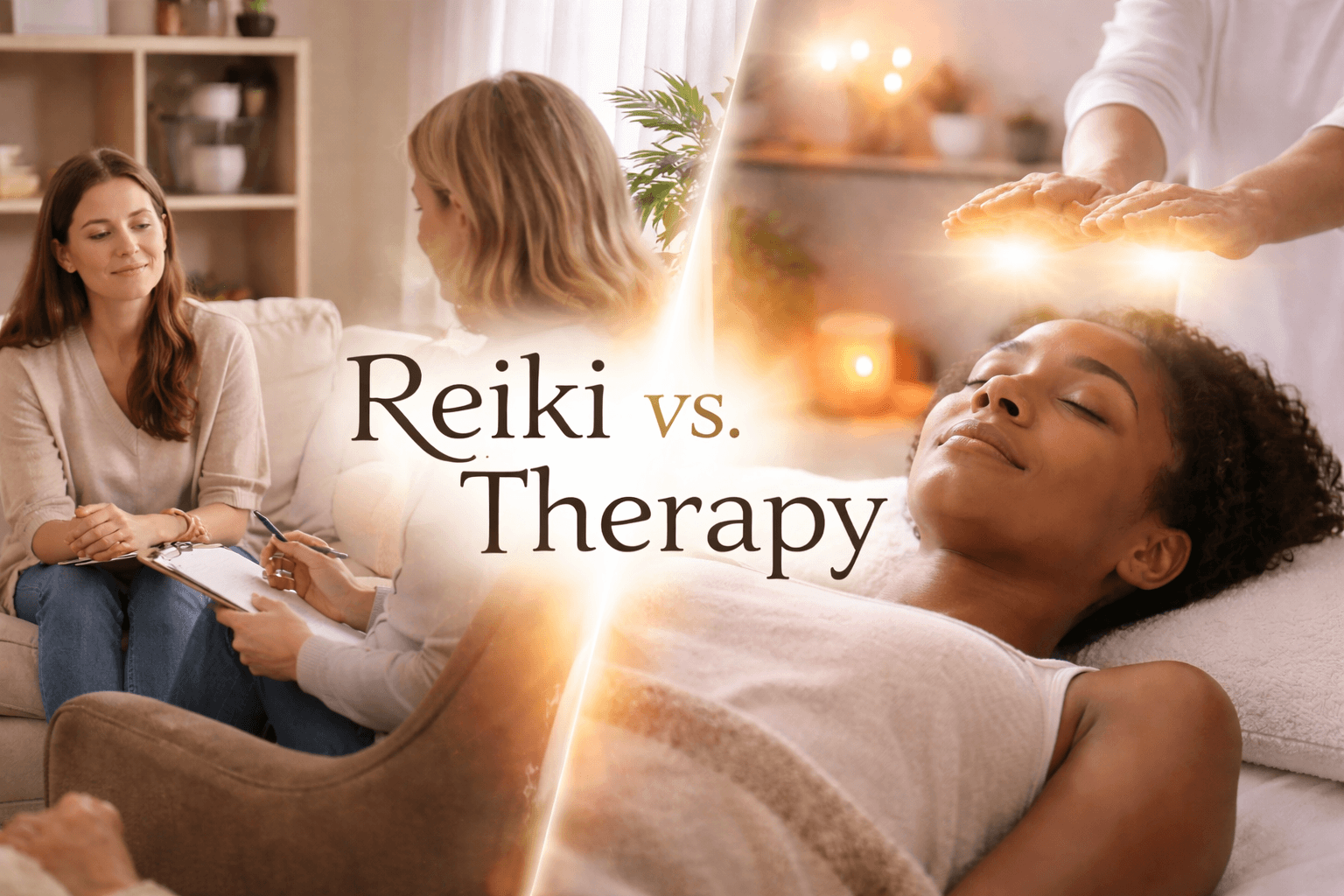
As more people explore holistic wellness, a common question begins to surface: Is Reiki the same as therapy? And perhaps more importantly, what does science actually say about both?
The truth is that Reiki and traditional therapy serve different purposes, even though they often support the same goal. Both help people heal, find clarity, and feel more balanced. They simply work through different pathways.
Understanding where science provides answers and where personal experience fills the gaps can help you decide what kind of support feels right for your journey.
What Therapy Is Designed to Do
Therapy, sometimes called psychotherapy or counseling, is grounded in psychological science. Licensed therapists are trained to help individuals understand thoughts, emotions, behaviors, and life patterns.
Through conversation and structured techniques, therapy can help people:
- Process trauma and past experiences
- Develop coping strategies
- Improve relationships
- Manage anxiety, depression, and stress
- Change harmful behavioral patterns
Science strongly supports therapy because it can be measured through observable outcomes such as symptom reduction, emotional regulation, and behavioral change.
Therapy works primarily through the mind. It helps you understand why you feel the way you do.
What Reiki Is Designed to Do
Reiki approaches healing from a different perspective. Instead of analyzing thoughts, Reiki focuses on energetic balance and relaxation within the body.
During a Reiki session, practitioners channel gentle healing energy through light touch or hands placed just above the body. Many people experience deep calm, emotional release, or a sense of inner peace.
Rather than talking through problems, Reiki creates stillness where the nervous system can reset.
People often describe Reiki as helping them feel aligned rather than analyzed.
Where Science Supports Reiki
Science does not currently measure energy healing in the same way it measures psychological therapy. However, research has explored some measurable effects associated with Reiki sessions.
Studies have observed that Reiki may help promote relaxation responses such as:
- Reduced stress markers
- Lower heart rate and blood pressure
- Improved mood and perceived well-being
- Better sleep quality
These outcomes are scientifically measurable because they relate to the nervous system’s relaxation response.
In simple terms, science can measure how the body reacts to Reiki, even if it cannot fully explain why individuals experience energetic shifts.
Where Science Has Limits
Science relies on repeatable measurement. Spiritual experiences, intuition, and subjective feelings are harder to quantify.
Many aspects of Reiki fall into areas science has not yet fully explained, including:
- The experience of energy flow
- Spiritual connection or insight
- Emotional release without conversation
- Intuitive awareness during sessions
This does not mean these experiences are invalid. It simply means current scientific tools are designed to measure physical processes more easily than internal or spiritual experiences.
Throughout history, science has often explained phenomena long after humans experienced them.
Reiki and Therapy Are Not Opposites
One of the biggest misconceptions is that Reiki and therapy compete with each other. In reality, many people benefit from using both.
Therapy helps organize thoughts and understand emotional patterns. Reiki helps calm the nervous system and restore energetic balance.
You might think of therapy as working through the story of your experiences, while Reiki helps quiet the emotional noise surrounding that story.
Some individuals attend therapy to process life events while receiving Reiki to relax, recharge, and reconnect with themselves on a deeper level.
Choosing What You Need Right Now
Healing is not one-size-fits-all. At different stages of life, different tools become helpful.
Someone experiencing active trauma or needing structured psychological support may benefit most from therapy. Someone feeling mentally overwhelmed, energetically drained, or spiritually disconnected may feel drawn toward Reiki.
Many people naturally move between both depending on their needs.
The important question is not which practice is better. The question is which type of support your mind, body, and spirit are asking for right now.
The Meeting Point Between Science and Spirituality
Science explains mechanisms. Spiritual practices explore meaning and experience.
Reiki exists in the space where relaxation, awareness, and personal transformation meet. Even when science cannot fully define the energetic experience, it continues to observe measurable benefits related to calmness and well-being.
For many individuals, Reiki becomes less about explanation and more about experience. Healing does not always require understanding every mechanism involved. Sometimes it begins with simply feeling safe enough to relax.
Supporting Your Healing Journey with Trust in Divine Timing
Whether you are exploring Reiki for emotional balance, mental clarity, or spiritual support, finding the right environment matters.
At Trust in Divine Timing, Reiki sessions are offered in a peaceful and supportive setting designed to help you reconnect with calm, clarity, and inner balance. You can learn more about available services by visiting https://trustindivinetiming.com/services/.
Weekday and weekend sessions are available by appointment, allowing flexibility for your schedule. If you feel guided to begin your Reiki journey, you can schedule an appointment by completing the form at https://trustindivinetiming.com/schedule-appointment/. You may also call or text anytime to arrange an appointment.
Healing does not always require choosing between science and spirituality. Sometimes the most powerful path is allowing both understanding and experience to support you together.